 ≥99% HPLC
Batch testedIdentity by MS, purity by HPLC
Lot numberedCertificate filed per lot
Cold stored2 to 8 °C until dispatch
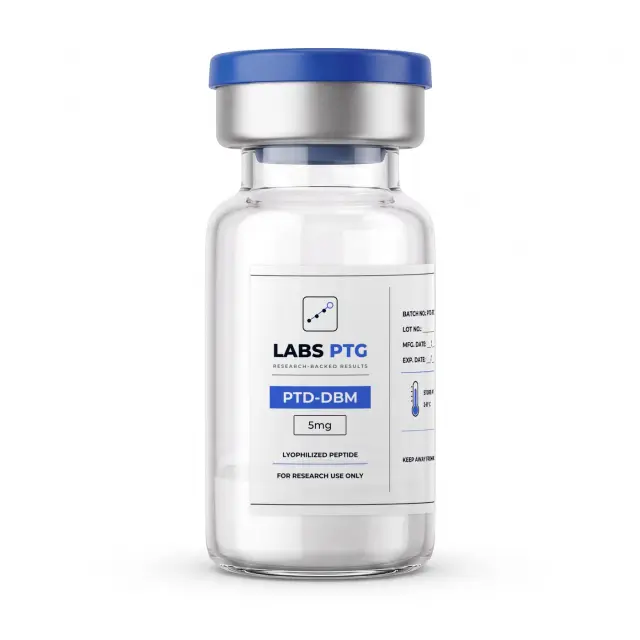
PTD-DBM
5mg lyophilised powder
A cell-penetrating peptide built to interrupt a CXXC5-Dishevelled contact, used in Wnt/beta-catenin signalling assays.
£80.90per vial, VAT included
In stock, dispatched same day before 16:00
- Free shipping on UK orders over £20.00
- Same day dispatch on orders placed before 16:00
- Batch certificate in the COA Database
Sold for research purposes only. For in-vitro laboratory research. Not a medicine and not for human or animal consumption. Supplied to qualified individuals aged 18 and over; you confirm this at checkout.
Research overview
PTD-DBM is a 25-residue cell-penetrating peptide that combines an octa-arginine protein transduction domain, a GGGG linker and a Dishevelled-binding motif. It is built to interrupt a CXXC5-Dishevelled contact and is used in Wnt/beta-catenin signalling assays. Supplied at 5mg as a lyophilised powder for in-vitro laboratory research only.
CXXC5 is a negative regulator of Wnt/beta-catenin signalling. It binds Dishevelled (Dvl) through its PDZ domain and so dampens the pathway. The Dishevelled-binding motif in this peptide mimics the CXXC5 region that contacts Dvl, and the arginine-rich domain carries it across cell membranes. Competing for that contact is reported to release the brake on Wnt signalling, raising beta-catenin levels and TCF/LEF reporter activity in cultured cells.
Typical assays use TOPflash or similar TCF/LEF luciferase reporters, western blotting for beta-catenin and Dvl, pull-down and proximity assays for the CXXC5-Dvl interaction, and cultured dermal papilla or fibroblast cells. Controls with scrambled motifs or the transduction domain alone are standard. Cell-penetrating peptides can stick to plastic, so low-binding tubes are often used.
Research areas
- Wnt/beta-catenin reporter assays
- CXXC5-Dishevelled interaction
- Cell-penetrating peptide uptake
- Dermal papilla and fibroblast cultures
- Scrambled-motif and transduction-domain controls
Specifications
- Molecular formula
- C124H225N61O28S2
- Molecular weight
- ~3082.62 g/mol (supplier analytical data)
- Sequence
- RRRRRRRRGGGGRKTGHQICKFRKC (octa-arginine PTD + GGGG linker + Dishevelled-binding motif, 25-mer)
- Form
- lyophilised powder
- Purity
- ≥99% (HPLC)
- Also known as
- PTD-DBM; Protein Transduction Domain-Dishevelled Binding Motif peptide; CXXC5-Dishevelled interaction inhibitor
- Supplied as
- 5mg per vial, lyophilised powder
Storage and handling
Store the lyophilised powder in a freezer, protected from moisture and light, and let the vial reach room temperature before opening. The peptide is highly charged and can stick to plastic, so use low-binding tubes after reconstitution.
Certificates of analysis
Each lot of PTD-DBM is released with a certificate recording identity and purity. Enter the lot number printed on your vial on the lab testing page to view it.
Questions
What are the parts of PTD-DBM?
An octa-arginine protein transduction domain helps the peptide enter cells, a GGGG linker separates the parts, and the Dishevelled-binding motif is the sequence designed to compete for the CXXC5 contact.
How is PTD-DBM supplied?
It is supplied as a lyophilised powder in a 5mg vial. Keep it cold, dry and away from light, and reconstitute with a suitable laboratory diluent only when the material is needed.
Is PTD-DBM a medicine?
No. It is supplied strictly for in-vitro laboratory research. It is not a medicine, food or supplement, and it is not for human or animal use. Buyers must be aged 18 or over.
Skin and matrix
Studied alongside