 ≥99% HPLC
Batch testedIdentity by MS, purity by HPLC
Lot numberedCertificate filed per lot
Cold stored2 to 8 °C until dispatch
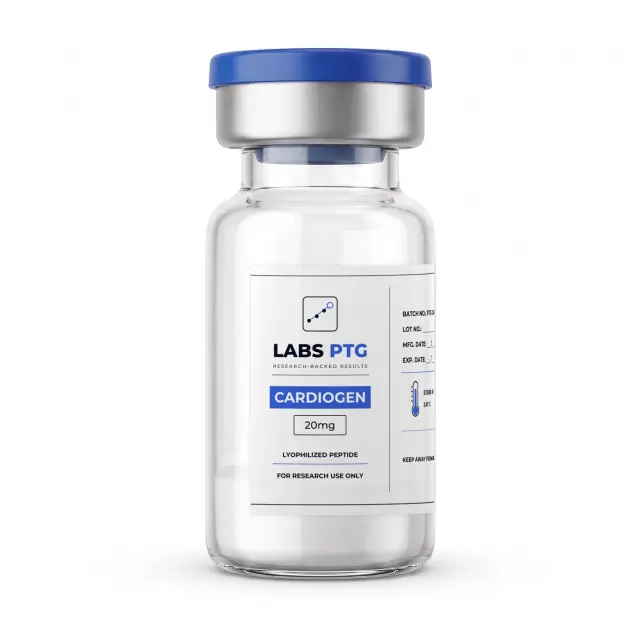
Cardiogen
20mg lyophilised powder
A short bioregulator-type peptide studied in heart-muscle and cardiac fibroblast cultures for gene expression and oxidative-stress responses.
£41.90per vial, VAT included
In stock, dispatched same day before 16:00
- Free shipping on UK orders over £20.00
- Same day dispatch on orders placed before 16:00
- Batch certificate in the COA Database
Sold for research purposes only. For in-vitro laboratory research. Not a medicine and not for human or animal consumption. Supplied to qualified individuals aged 18 and over; you confirm this at checkout.
Research overview
Cardiogen is a short bioregulator-type peptide, Ala-Glu-Asp-Arg (AEDR). It is studied in cardiomyocyte and cardiac fibroblast cultures for gene expression and oxidative-stress responses, and belongs to the family of very short peptides described largely by the Khavinson group. Supplied at 20mg as a lyophilised powder for in-vitro laboratory research only.
Cardiogen is one of the tetrapeptide bioregulators proposed to reproduce part of the activity of tissue extracts, in this case from cardiac tissue. The family hypothesis is that such peptides reach the nucleus and interact with promoter regions or chromatin proteins, shifting expression of tissue-specific genes. In cultured cardiac cells, Cardiogen has been reported to alter proliferation markers, to modulate collagen and other matrix genes in fibroblasts and to change responses to oxidative stress. Evidence is concentrated in a small number of laboratories.
Typical laboratory designs use neonatal cardiomyocytes, cardiac fibroblasts or cell lines, with readouts including viability and proliferation assays, reactive oxygen species probes, qPCR of matrix and stress genes and immunostaining. Peptide uptake and nuclear localisation can be followed with labelled analogues. It is supplied as a lyophilised powder in a 20mg vial.
Research areas
- Cardiomyocyte and cardiac fibroblast cultures
- Oxidative-stress response assays
- Extracellular matrix gene expression
- Promoter and chromatin interaction hypotheses
- Cellular uptake of very short peptides
Specifications
- Molecular formula
- C18H31N7O9
- Molecular weight
- 489.49 g/mol
- Sequence
- Ala-Glu-Asp-Arg
- One-letter code
- AEDR
- Form
- lyophilised powder
- Purity
- ≥99% (HPLC)
- Also known as
- Cardiogen; AEDR
- Supplied as
- 20mg per vial, lyophilised powder
Storage and handling
Store the lyophilised powder in a freezer, protected from moisture and light, and let the vial reach room temperature before opening. Reconstitute with an appropriate laboratory diluent and keep reconstituted material cold.
Certificates of analysis
Each lot of Cardiogen is released with a certificate recording identity and purity. Enter the lot number printed on your vial on the lab testing page to view it.
Questions
What does the name Cardiogen refer to?
The name reflects the cardiac-tissue focus of this peptide in the bioregulator literature. The compound itself is the four-residue sequence Ala-Glu-Asp-Arg (AEDR).
How is Cardiogen supplied and stored?
It is supplied as a lyophilised powder in a 20mg vial. Keep it cold, dry and away from light, and reconstitute with a suitable laboratory diluent only when the material is needed.
Is Cardiogen a medicine?
No. It is supplied strictly for in-vitro laboratory research. It is not a medicine, food or supplement, and it is not for human or animal use. Buyers must be aged 18 or over.
Longevity and bioregulators